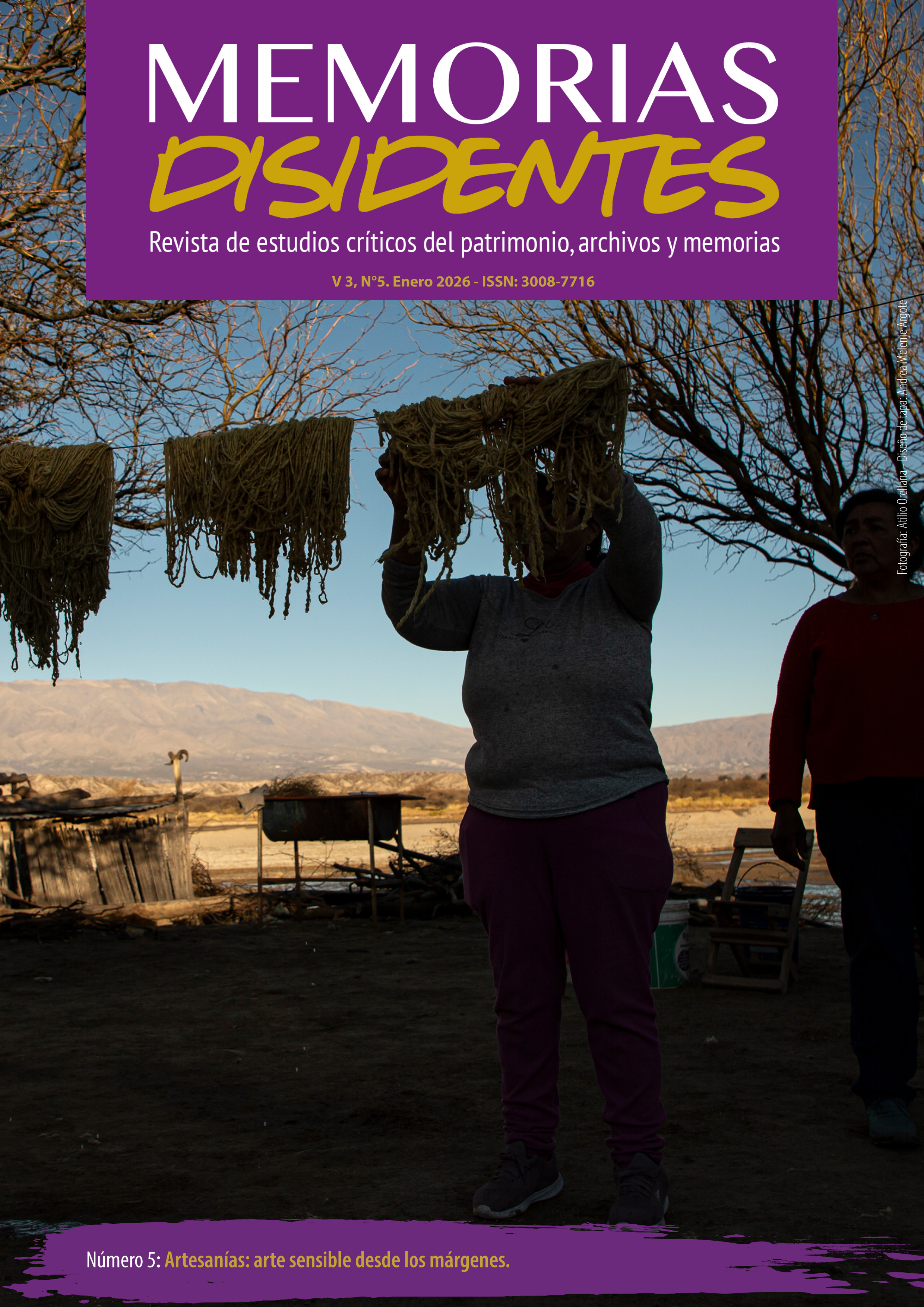
Introduction to the dossier handirafts: sensitive art from the margins
DOI:
https://doi.org/10.64377/30087716.1471Keywords:
Sensitive art, nature in mourning, educating attention, responsibility, cosmopraxis.Abstract
With the certainty that a diversity of worlds exists that we neither see, nor hear, nor smell, much less understand—because all the categorical frameworks we have inherited are insufficient to name them and always, in some way, betray the binding spirituality—this article invites us to reflect on the daily, resilient, and life-giving work of communities, carried out by individual or collective makers with a wealth of knowledge embedded in lineages, mandates, gestures, passions, routines, and techniques. Guided by the hypothesis that artisanal practice operates and contests its meanings within several simultaneous ontological regimes, this article proposes to open a space for reflection on handicrafts, artisans, and artisanal trades, from a relational perspective and taking into account the debates surrounding the place of crafts in the world of art and design.
References
Ahmed, Sara (2019). La promesa de la felicidad. Una crítica cultural al imperativo de la alegría. Caja Negra.
Blaser, Mario (2024). Incomún. Un ensayo de ontología política para el fin del mundo (único). Cebra.
Boym, Svetlana (2017). Off modern. Bloomsbury Academic.
de la cadena, Marisol (2019). Cosmopolítica indígena en los Andes: reflexiones conceptuales más allá de la “política”. Tabula Rasa, 33, 273-311. https://doi.org/10.25058/20112742.n33.10
Despret, Vinciene (2022). Habitar como un pájaro. Modos de hacer y de pensar los territorios. Cactus.
Dreidemie, Patricia (2011). ‘Nosotros lo hablamos mezclado’. Estudio etnolingüístico del quechua hablado por migrantes bolivianos en Buenos Aires (Argentina). IIDyPCa/CONICET-UNRN.
Dreidemie, Patricia (2023). La artesanía indígena en la composición de mundos. Hacia una exploración etnolingüística. Cuadernos de Literatura, 21, 1-16. https://doi.org/10.30972/clt.0216887
Escobar, Ticio (2004). El arte fuera de sí. CAV Museo del Barro – FONDEC.
Escobar, Ticio (2021). Aura Latente. Estética, ética, política, técnica. Editorial Tinta Limón
Haraway, Donna J. (2019) [2016]. Seguir con el problema. Consonni.
Ingold, Tim (2015). The Life of Lines. Routledge.
Latour, Bruno (2022). Nunca fuimos modernos. Ensayos de antropología simétrica. Siglo XXI.
Morton, Timothy 2019 [2018]. Ecología oscura; hacia una lógica de coexistencia futura. Paidós.
Munter, Koem (2016). Ontología relacional y cosmopraxis. Desde los Andes. Visitar y conme¬morar entre familias aymara. Chungara, Revista de Antropología Chilena, 48(4), 629-644. http:// dx.doi.org/10.4067/S0717-73562016005000030
Quijano, Aníbal (2020) [2011]. Bien vivir. Entre el “desarrollo” y la des/colonialidad del poder. En Cuestiones y horizontes: de la dependencia histórico-estructural a la colonialidad/descolo¬nialidad del poder. CLACSO. 937-952. https://doi.org/10.2307/j.ctv1gm019g
Ostrom, Elinor (2009). A General Framework for Analyzing Sustainability of Social-Ecologi¬cal Systems. Science. 325(5939), 419-422. https://doi.org/10.1126/science.1172133
Saidel, Matías L. (2017). La tragedia de los comunes revisitada: de la teoría formal a las formas históricas de desposesión. Temas y Debates 33 21. 163-184. https://doi.org/10.35305/ tyd.v0i33.359
Secretaría de Cultura, Gobierno de México (23 de noviembre de 2021). Comunicado. “Presentarán avances del proyecto “El caracol púrpura: difusión de 35 años de defensa y promoción de un recurso bio-cultural”. https://www.gob.mx/cultura/prensa/presentaran-avances-del-proyecto-el-caracol-purpura-difusion-de-35-anos-de-defensa-y-promocion-de-un-recurso-bio-cultural-288794
Segato, Rita (2015). La crítica de la colonialidad en ocho ensayos. Y una antropología por demanda. Prometeo.
Segato, Rita [Universidad de Rio Negro] (29 de octubre de 2025). Doctorado Honoris Causa a Rita Segato. [Video]. El arte de nombrar construye la historia. Conferencia magistral. https://www.youtube.com/live/Lzr61JX5S7A?si=3mr_5_CqHdtApCCK
Sennett, Richard (2009). El artesano. Anagrama.
Stengers, Isabelle (2014). La propuesta cosmopolítica. Pléyade 14. 17-41.
Strathern, Marilyn (1992). Reproducing the Future. Manchester UP.
Svampa, Maristella y Viale, Enrique (2020). El colapso ecológico ya llegó. Una brújula para salir de los modelos de (mal)desarrollo. Siglo XXI.
Turok, Marta (1988a). Cómo acercarse a la artesanía. Plaza y Valdés Editores.
Turok, Marta (Coord.) (1988b). El Caracol púrpura: una tradición milenaria en Oaxaca. SEP-CN¬CA-Dirección General de Culturas Populares e Indígenas.
Tsing, Anna Lowenhaupt (2023) [2015]. Los hongos del fin del mundo; sobre la posibilidad de vida
en las ruinas del capitalismo. Caja Negra.
Van Dooren, Thom (2016). Flight ways. Life and Loss at the Edge of Extinction. Columbia UP.
Downloads
Published
How to Cite
Issue
Section
License
Copyright (c) 2026 Patricia Dreidemie

This work is licensed under a Creative Commons Attribution-NonCommercial-ShareAlike 4.0 International License.

-
The authors retain the rights of autxr and assign to the journal the right to first publication of the work, registered under the Creative Commons attribution license, which allows third parties to use what is published as long as they mention the authorship of the work and the first publication in this journal.
-
Authors may make other independent and additional contractual agreements for the non-exclusive distribution of the version of the article published in this journal (for example, including it in an institutional repository) as long as they clearly indicate that the work was first published in this journal.
-
The authors grant any third party the right to share and use the article (for non-commercial purposes), provided that the original authors and the citation of the version published in this journal are identified.