
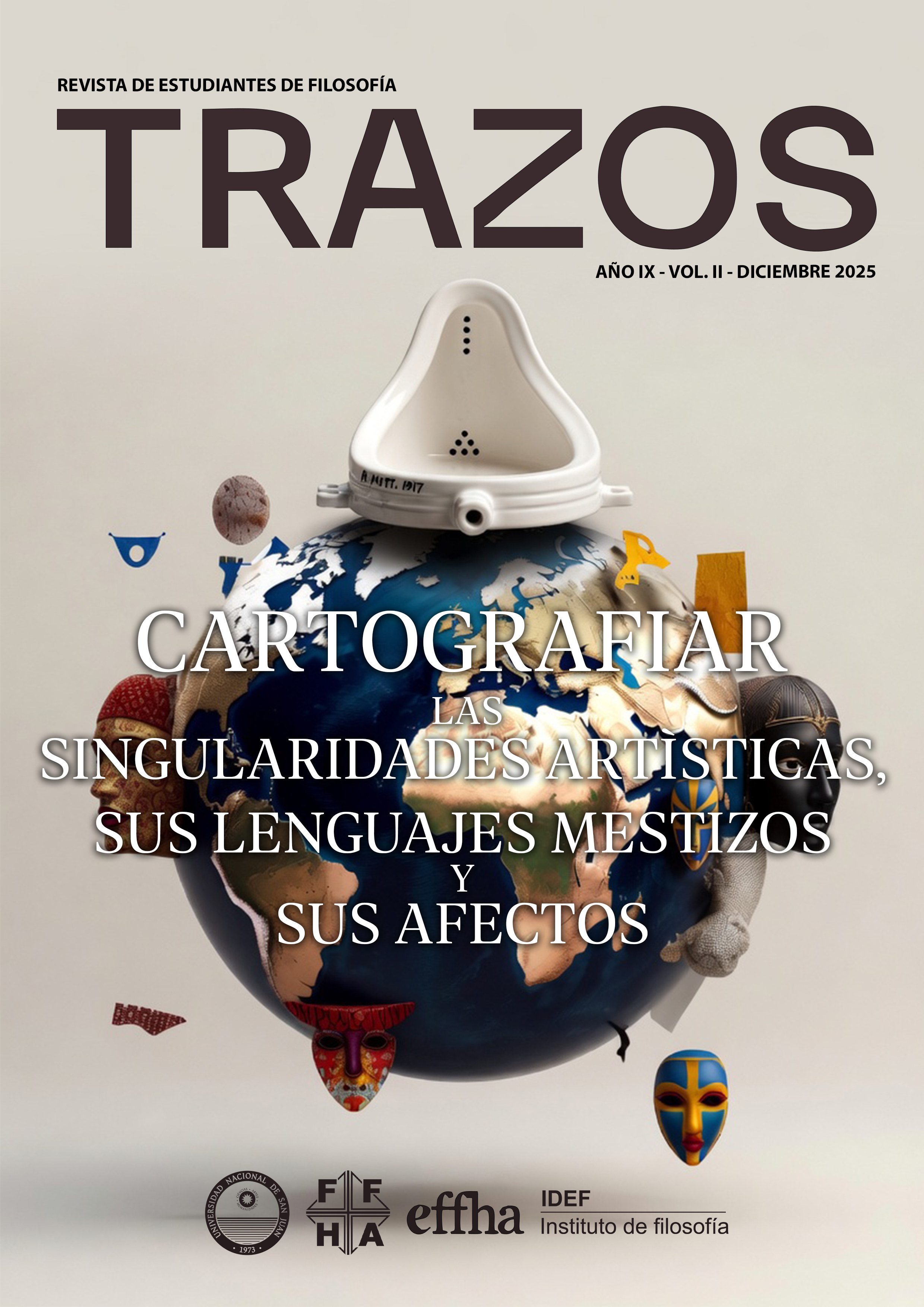
Mapping artistic singularities, hybrid languages, and affects
Vol. 2 No. 9 (2025)
This dossier unfolds a critical reading, cartographic in orientation, of contemporary artistic practices that compose their languages through the crossing of modes of production, forms of enunciation, and procedures. The texts gathered here reconstruct the itineraries of these works and their modes of operation, attending to the connections each practice activates among materials, bodies, memories, and territories. This reconstruction makes it possible to recognize how certain operations render visible, sensible, or shareable what had remained displaced from dominant modes of reading. The essays thus open questions about the presences that the works bring forth, the affects they mobilize, and the conditions under which an experience may be inscribed within a shared field of sensibility and meaning.
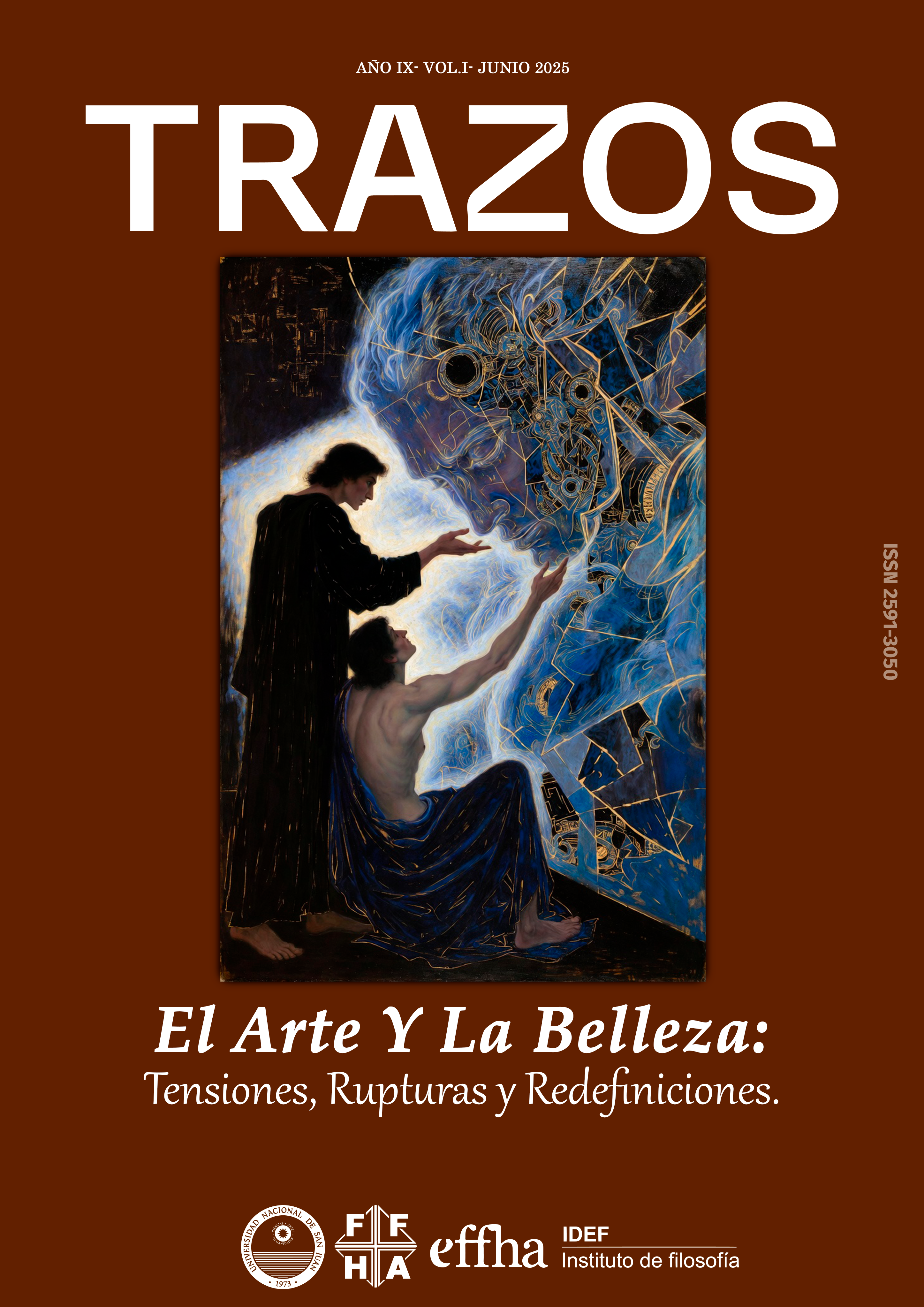
Art and beauty: tensions, ruptures and redefinitions
Vol. 1 No. 9 (2025)
Analyzing the historical development of the various artistic movements that have emerged in the West, from Antiquity to the present day, it becomes clear that the concept of "art" has not always been the same. Even today, contemporary art presents us with a diversity of artistic productions to which the same categories that once characterized artistic practice—beauty, harmony, purity, and a long list of concepts that for centuries have been associated with art and aesthetic experience—can hardly be applied. The contemporary landscape and historical analysis seem to reveal that there is no single, shared understanding of what art truly is.

Dissident epistemologies: philosophical explorations of how we construct knowledge situated with (and against) disciplinary epistemologies
Vol. 2 No. 8 (2024)
Within the philosophical field, epistemology is an area dedicated to the study of knowledge: its modes and circumstances, but also who can know it and under what conditions. This has been widely problematized by now-iconic authors such as Donna Haraway from the scientific field or María Lugones from a decolonial stance, to name just a few. In the case of the former, for example, we particularly consider her comments about the role of the "modest witness" (Haraway, 2004) in science. And that resonance here has to do with the problematization of the objectivity and/or neutrality of scientific knowledge. Regarding the sex-gender dimension, this is not only a problem of "women" in science, but also of who are considered legitimate subjects of knowledge and what knowledge is proposed as valuable.
Through this call, then, we aim to expand and diffract these critical analyses to other dimensions and other subjective conformations (deformations, misinformation) that differ from the disciplinary epistemological knowledge about the world and about knowledge itself. In this sense, we believe that the possibility of developing situated dialogues around contemporary epistemological debates in our territories is fundamental to producing theoretical densities capable of accounting for a turbulent time. Dialogues that can not only diagnose but also conceptually intervene in the dominant matrices of intelligibility.
This can lead us to various concerns: How is it possible to speak of "situated knowledge" without assuming the transparency of the researcher as a sine qua non condition? That is, without positioning ourselves in a place of self-invisibility. (How) do contemporary sociopolitical (and affective) frameworks affect thinking about the possibilities of knowledge, especially academic knowledge? What epistemological tools are (useless) for us in noticing the very webs of intelligibility in which we participate directly or indirectly? As well as questions about time, such as ruminative epistemology (Massón, 2023) or even asterisk epistemologies (Radi, 2020) that recover and/or propose travesti-trans-non-binary epistemologies.
The fictional construction of the political imaginary: between rhetoric and social ontology
Vol. 1 No. 8 (2024)
The political imaginary of a society, as a human artifice, requires being thought of in constructivist terms. The various theories of fiction help us understand how the conceptual realms in which we move and develop our political practices are constructed. These fictional processes, of course, are far from being opposed to reality, but rather involve fiction as a delimiter of the conceivable, of what can be modeled by verbal means. Following Hayden White, we are convinced that there is a primarily ethical responsibility in the fictional procedures used to construct the conceptual artifacts through which we intervene in society and imagine it. Technological development over the last few decades and global changes in the geopolitical landscape have led to various imaginings about the future. Prospective, which involves the ability to imagine possible future scenarios from elements that arise from our present, such as political, economic, social, and technological, among others, becomes a fundamental tool when thinking about fiction theories. Following Mark Fisher, in capitalism, theory-fiction is no longer represented or coded as "fantasy," but rather anticipates the Real by capturing its tendencies or virtual potentials, and then influences reality and contributes to its configuration by actualizing these potentials. Thus, the prevailing narrative about possible future scenarios generates a collective narrative identity that allows modeling the future to come and avoid the emergence of the new, since everything that is coming is expected. The new should not be confused with an adaptation to the present. The new must allow the creation of the unexpected, which generates the estrangement that makes possible the state of shock necessary for the emergencies of alternatives to the capitalist system. This gaze seems to dissolve into the concept of hungology, whose nostalgia refers to persistence, repetition, and prefiguration that seem to delay the arrival of an alien future, a future completely opposite to the present. The goal of this call is to engage in dialogue with a future that currently oscillates between apocalyptic scenarios and updated or eternalized presents. To do this, it is necessary to develop a field of study that involves a deep analysis of the ontological assumptions that operate in our present and therefore shape our political imaginary for the future. A critical review of how the metaphors we use to conceptualize and the tropes we use to weave the discourses about public space and its evolution operate. In the philosophy of the last 50 years, there are many and varied currents that allow us to problematize this topic and that we propose as lines of work for this dossier: Laclau's rhetorical constitution of society, Hayden White's narrativism, Derrida's philosophy of difference, the contributions of Gilles Deleuze, Žižek, Rancière, Sadin, or even modern authors like Marx and Spinoza. We invite the entire community to submit their contributions on this topic, which we believe is currently a pressing issue for philosophical debate.

Overflowing Corporalities: The Power of the Monstrous in Artistic Practices
Vol. 2 No. 8 (2023)
The monstrous can not only be thought of as a normalizing device but also as a space of resistance that, due to its untamed, liminal, and unstable quality, allows the questioning of the binaries of the hetero-cis-capitalist-colonial system. A system that has organized bodies (human, non-human, cosmic, scriptural, disciplinary, etc.) as atomized entities, always equal to themselves and always in the service of the expansion of capital. In this context, we are interested in asking how artistic practices can function from a monstrous doing/knowing that overflows, disorganizes, and problematizes corporality, not from the usual dichotomies, but from an inasible "in between," a dispersion and movement (Ulm, 2021 ), a mestizo and ch'ixi thinking (Anzaldúa, 201 6 and Rivera Cusicanqui, 201 5). We invite you to reflect on art as a practice of thought that can enhance the monstrous and promote questions that challenge us to keep thinking: How can we open up readings of culture(s) from the monstrous artistic practices that they engender? What is the fate of artistic creation that escapes the canon, that opens political horizons, that poses resistance, mutations, dislocations, overflows, that is not domesticated, that resignifies fictions, that disrupts, that is a threshold, that vacillates and/or breaks the law? What knowledge and understanding do artistic practices (literary, visual, audiovisual, performative, etc.) contribute to the reinterpretation of the monstrous? What is the power of overflowing bodies; individual bodies, collective bodies, bodies of work, texts, territories?
Neoliberalism and biopolitics: about the relationship between politics and life in the era of neoliberal governmentality
Vol. 1 No. 7 (2023)
At the end of the seventies, Michel Foucault presented a series of investigations on the mutations of power in modernity, which constitute what has become known as the biopolitical corpus of his work. With this, the way was opened to a new conception of power whose function is no longer to kill, but to govern - by intervening and enhancing - the biological life of populations. From these analyses, the relationship between politics and life not only became evident, but also became unavoidable material for philosophical-political reflections. However, in our time such a relationship takes other forms in line with the new modalities of neoliberal government. Although Foucault had already warned that neoliberalism was a type of rationality of government, the study of the existing links between neoliberal governmentality and biopolitics remained pending, and continues to be a terrain to explore. More than 40 years after the formation of said theoretical corpus, we then ask ourselves about its validity and updating. According to this, what are the new forms of control and administration of the biological life of populations in the current neoliberal context? If neoliberal governmentality proceeds through social insecurity, how is the life of the most precarious populations protected and enhanced? This Dossier invites us to explore the ways in which the relationship between politics and life is problematized by contemporary Political Philosophy, especially from the Foucauldian theoretical body, but also from readings that displace, rework or mix it with other proposals to think about the current neoliberal context.
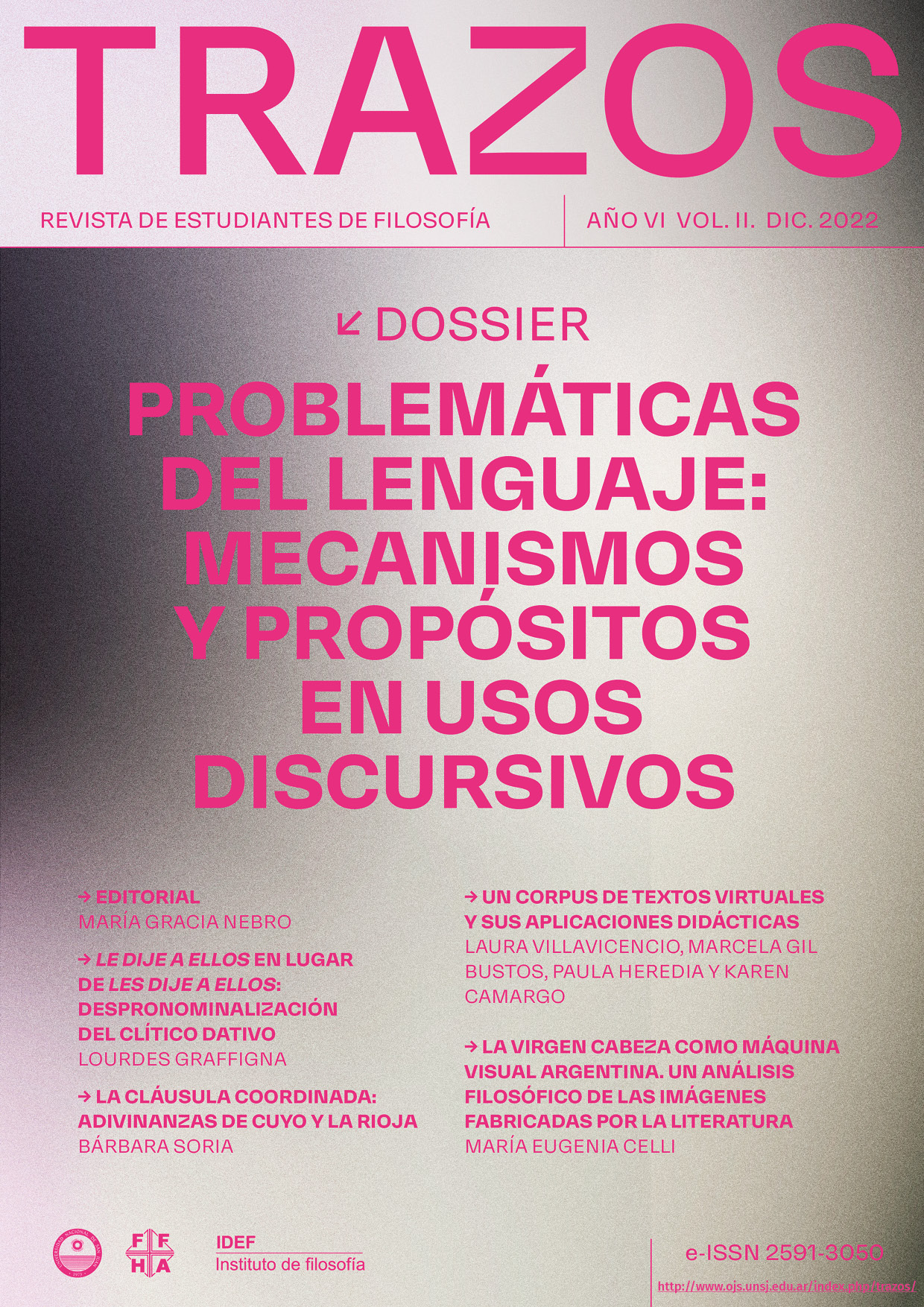
Language Issues: Mechanisms and Purposes in Discursive Uses
Vol. 2 No. 6 (2022)
One of the current problems in language studies is the principle that linguistic categories are discrete and perfectly bounded. During these last decades, instead of considering them as closed and well-defined, we are understanding all categorization as a predominance or selection of attributes that represent it to a greater or lesser degree with respect to other categories. This look changes not only our way of studying certain mental processes but also our interpretation of the world. Linguistic analysis from prototype theory can refract a network of interpreted relationships that have been mentally grouped. For this reason, linguistic categories are interpreted as cognitive categories. On this occasion, we consider it necessary to return to some of these categories to value them and describe them with respect to others in the context of real linguistic uses. On the other hand, the challenge of describing and analyzing the use of the language by the speakers is based on considering language as a communication instrument made up of signs, whose design and structure are directly motivated by the communicative act. In other words, the syntax is not only semantically, but also pragmatically motivated. In this edition we ask ourselves: How, then, is grammar understood, studied and described, if linguistic routines are constantly renegotiated in speech according to the context of enunciation and the intentions of the speakers? The Dossier "Language Problems: Mechanisms and Purposes in Discursive Uses" aims to contribute to current language studies from the cognitive-prototypical perspective. We call, within the framework of discursive studies, to address studies of language and cognitive processes involved in the choice of linguistic forms. We will also consider the communicative intention of the speaker as an aspect to identify and describe from the analysis of discursive uses of real texts and their frequencies of use.
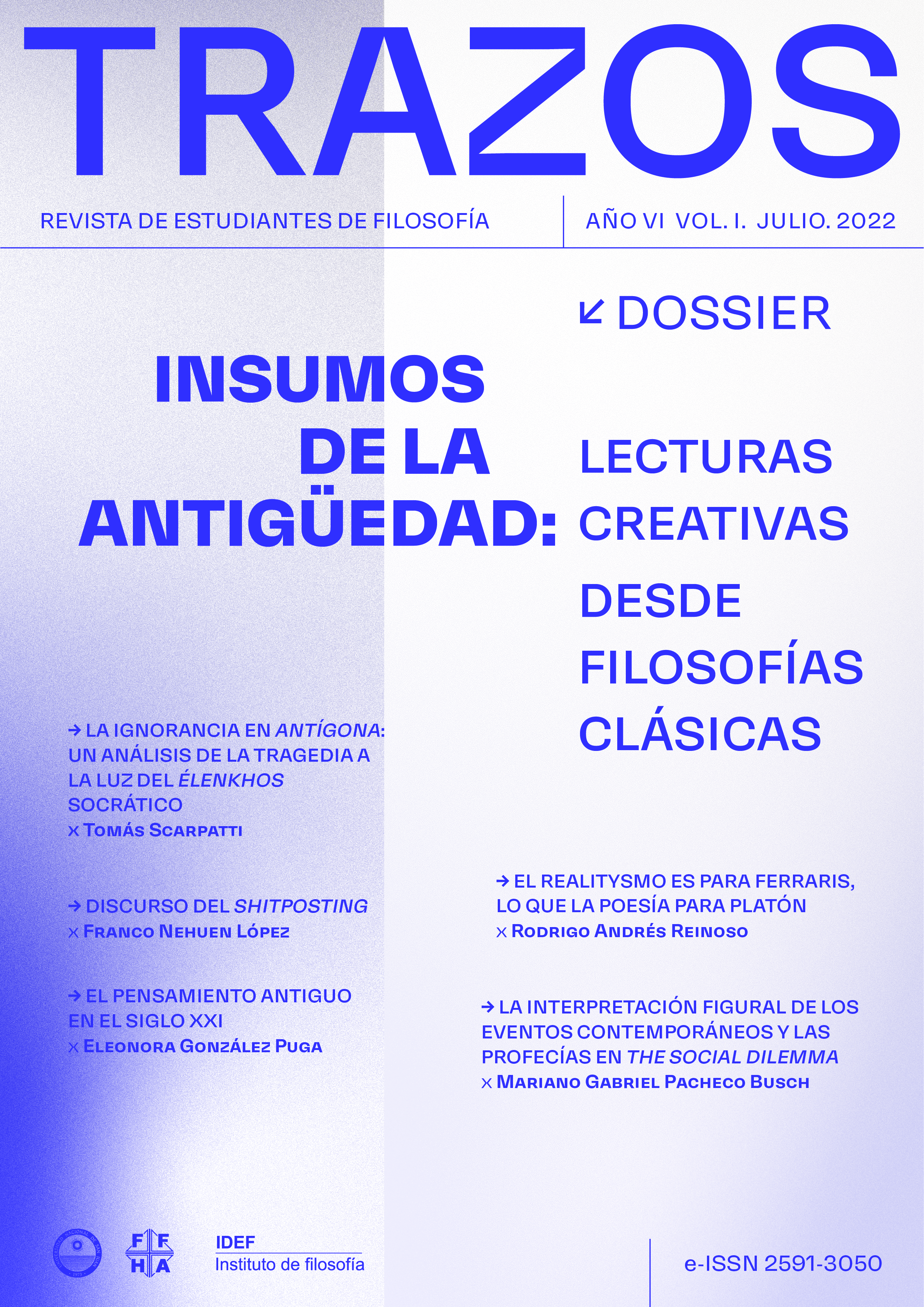
Inputs from antiquity: creative readings from classical philosophies
Vol. 1 No. 6 (2022)
A disturbing subject: philosophies and their times. Here we begin to weigh a new dossier proposal. We ask ourselves, where does the novelty lie? What is the value of rereads? That's where we think of creativity. Perhaps that is one of the words that inspires curiosity. It is difficult to ask ourselves about something without noticing the assumptions that rest under the terms we use, and this suggests another situation about how we think about ancient philosophies. It is common to assume that Ancient Philosophy rests below its later productions, just as the meanings run aground, agglutinating or accumulating in the terms. So much so that philosophy would seem to be composed of a constant series of repetitions of terms whose anchorage is traceable below what stands as novelty. It is difficult, for example, to think about politics without owing at least a margin of theorization to the concepts, ideas and meanings that Antiquity poured into that term. We suspect that there is no point, on the one hand, in wanting to evade the historical journey of the terms with which we make philosophical reflection today, nor in clinging to ancient appreciations as if it were a primordial truth, on the other.
Creativity is what we resort to in order to assume that readings are not exhausted, that all literature can be an input for alternative reflections. So Antiquity, in quotes, is susceptible to our view of multiple forms of revitalization, resignification or reflection (in the sense of looking back on the same) philosophical, and even more: we think that it is not the ideas or concepts, the terms or problems that remain at a specific time; but rather the way in which they have been worked. Today we see clear examples of readings, writings, works and ways of making ancient ideas or thoughts speak, but whose novelty necessarily lies in an ingenious pivot that provoked a contemporary reading and a new way of philosophical work. Today we want to invite you to rethink, make talk and write about this problem that we have selected as the theme of Dossier, which we have entitled: Inputs from Antiquity: creative readings from classical philosophies. We look forward to your input!
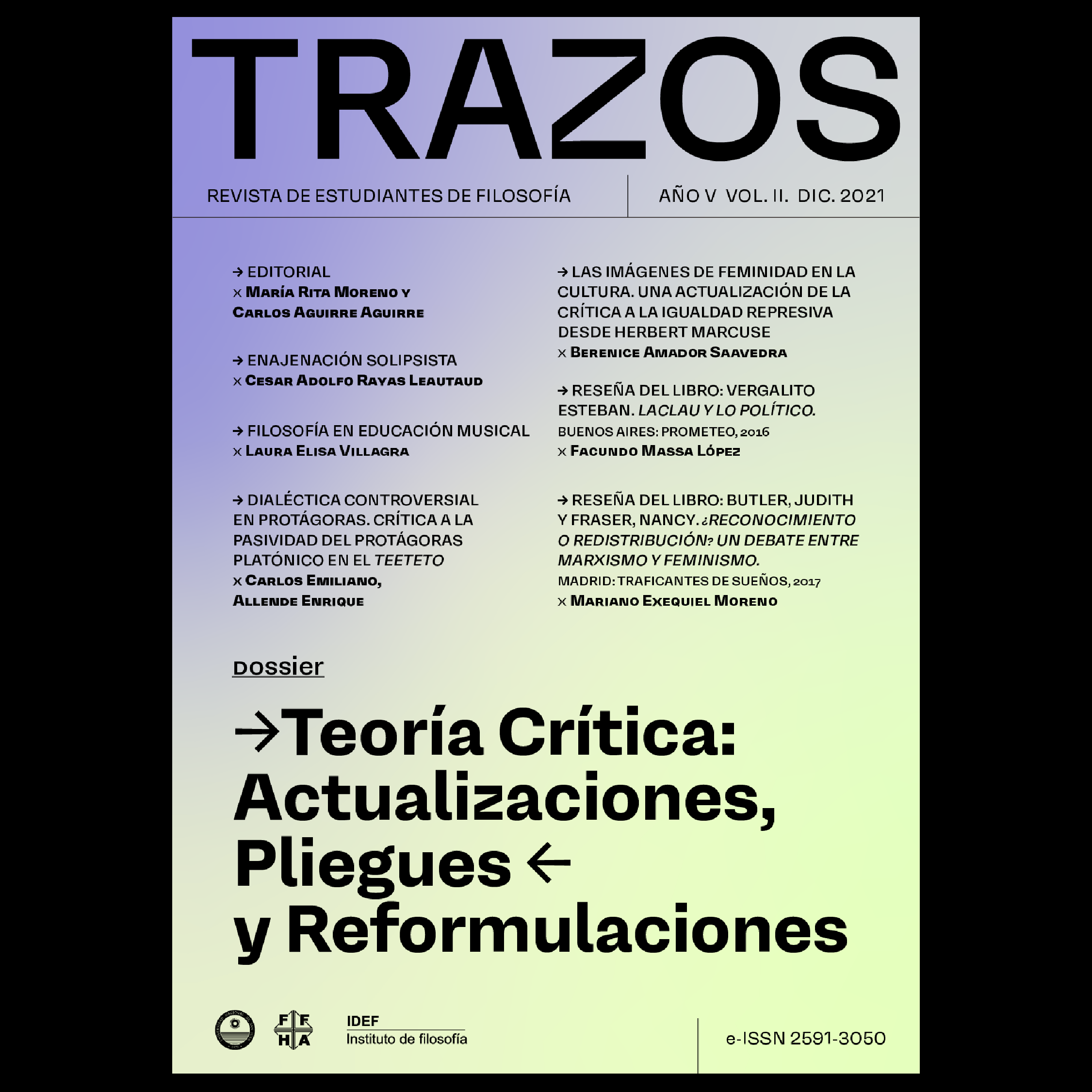
Critical Theory: updates, folds and reformulations
Vol. 2 No. 5 (2021)
The dossier aims to promote and sustain dialogue between different textual, aesthetic and academic resources related to the various geographical, political and epistemological locations of Critical Theory.
In recent decades the question of “the critical” ─ canonically installed in the 20th century by Max Horkheimer in Traditional Theory and Critical Theory (1937) ─ has undergone mutations , surveys and new configurations in different geocultural areas. Directly or indirectly, the initial concerns of Critical Theory have been crossed by displacements and surveys that modify its original meaning and its classic directions: the anti-colonial critiques of the second half of the 20th century, Enrique Dussel's Philosophy of Liberation, Latin American cultural criticism of the 1980s and 1990s, postcolonial theory, the Latin American decolonial turn, critical feminisms, Antonio Negri's theory of constituent power, and Nancy Fraser's anti-capitalism, just to name a few.
This pluralization and decentering of Critical Theory accounts for updates, folds and reformulations that deepen conjectures about narratives and conventional representations of what is understood by "critical ”. Some of the questions that guide the contributions to which this issue calls are: what are the main categories of Critical Theory that have spread in recent decades? Is it possible to think of a survey of Critical Theory in Latin America? What policies does Critical Theory enable in its classic and/or current formulations? What are the limits and possibilities of Critical Theory? How is Critical Theory updated?
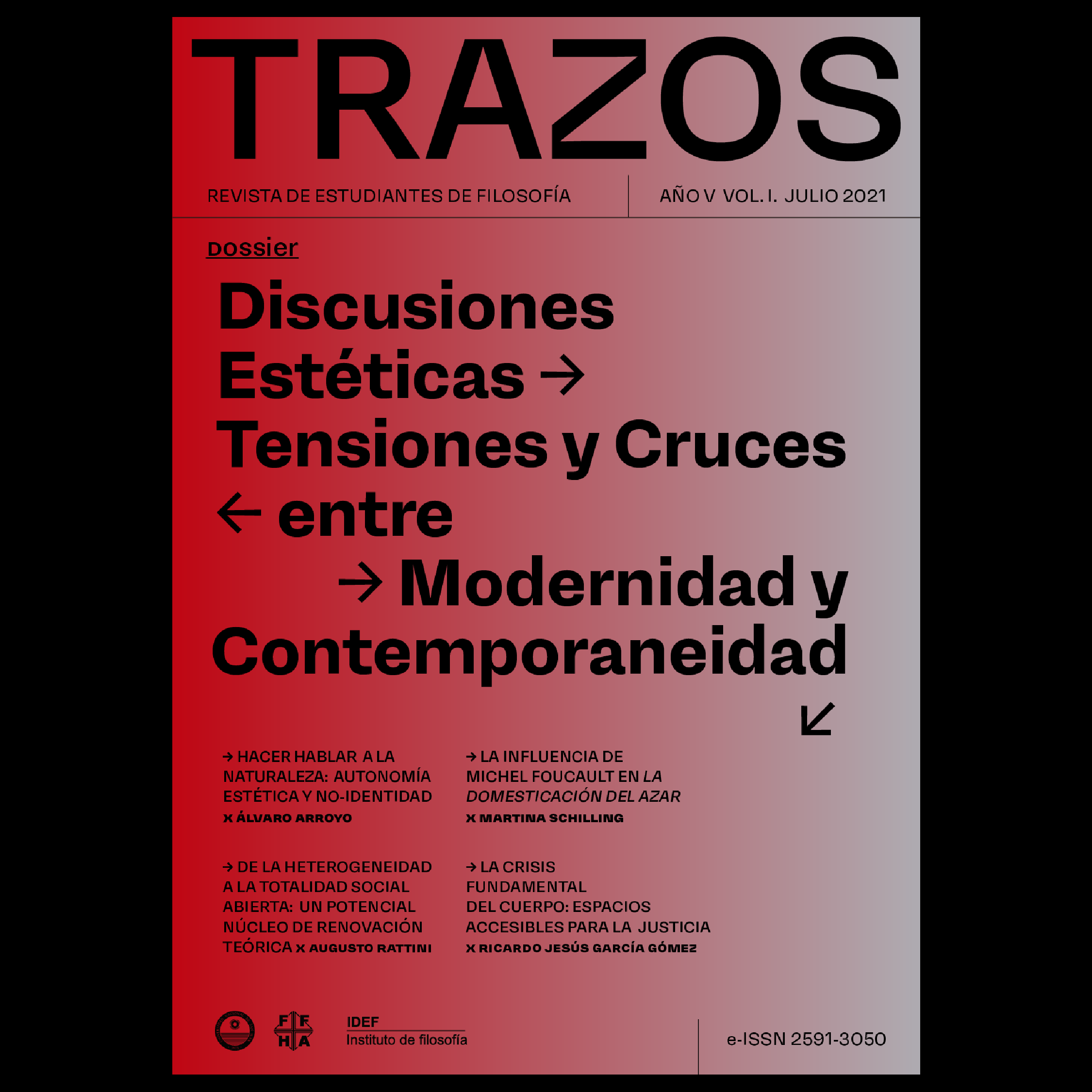
Aesthetic discussions: tensions and intersections between modernity and contemporaneity
Vol. 1 No. 5 (2021)
"In art it is difficult to say something that is as good as saying nothing ”. With these words Wittgenstein refers to aesthetics advising silence, but what is aesthetics if not to talk about art? And in that case, what is art? How to think aesthetics or how to think from that disciplinary field after a phrase as decisive as it is disturbing? If these questions are not complex enough to problematize, we can think about them by placing ourselves in the present. How is aesthetics outlined today? Perhaps Wittgenstein's words do not signal a withdrawal from aesthetics but rather promote a new theoretical commitment. We cannot ignore all the problems that have arisen throughout the history of aesthetics and art, for this reason we came up with multiple triggers to encourage publication in this Dossier.